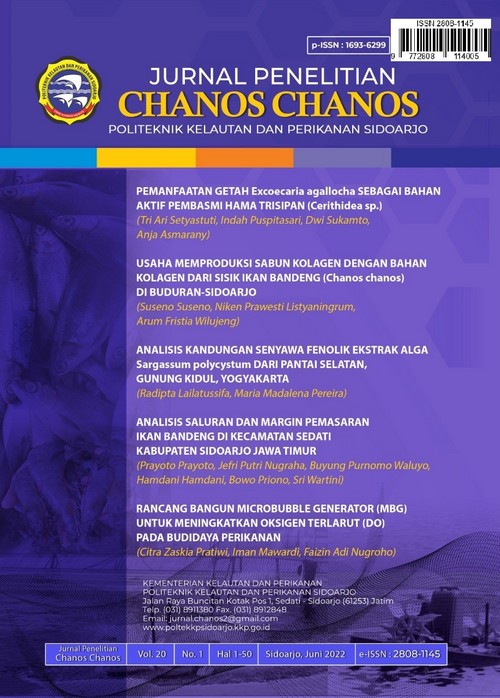
PEMANFAATAN GETAH Excoecaria agallocha SEBAGAI BAHAN AKTIF PEMBASMI HAMA TRISIPAN (Cerithidea sp.)
DOI:
https://doi.org/10.15578/chanos.v20i1.10512Keywords:
Excoecaria agallocha sap, trisipan, active ingredientsAbstract
Chemicals as pest and disease control in aquaculture production are suspected to contain potential toxicity to human health as well as harm to the environment, so this study aimed to use mangrove plants as pesticides made of organic material for pest control in shrimp ponds. One of the pests that are very disturbing is trisipan (Telescopium telescopium) from the Mollusca group. This study aimed to identify the active compounds contained in the latex of Excoecaria agallocha, to determine the cytotoxicity activity of the latex of Excoecaria agallocha and to determine the LC50 of the latex of E. agallocha against Trisipan. This research was conducted from September to December 2019 at the Mangrove Center Pulokerto Pasuruan and the Fish Pathology Laboratory of the Marine and Fisheries Polytechnic of Sidoarjo. The method used is experimental 6 treatments with 3 replications.
The results that can be concluded from this study are that the active compound content of Excoecaria agallocha latex has not been determined because it is still in the testing process, the cytotoxicity activity of Excoecaria agallocha sap in brackish water media is higher than the cytotoxicity activity in freshwater media and LC50 of resin E. agallocha against Trisipan was shown in Trisipan with brackish water media and a dose of 400 ppm.
References
Agoromoorthy, G., M. Chandrasekaran, V. Venkatesalu and M.J. Hsu. 2007. Antibacterial and Antifungal Activities of Fatty Acid Methyl Esters of the Blindyour-eye Mangrove from India. Brazillian Journal of Microbiology. 38:739-742.
Chakravarty, M. S. dan Ranjan T.J.U.. 2014. A Check List of Malacofauna From The Nuvvalarevu Backwaters of Srikakulam District, Andhra Pradesh, India. International Journal of Research in Marine Sciences; 3(1): 11-15
Eric Wei Chiang Chan, Nozomi Oshiro, Mio Kezuka, Norimi Kimura, Karin Baba, Hung Tuck Chan.2018. Pharmacological potentials and toxicity effects of Excoecaria agallocha. Journal of Applied Pharmaceutical Science 8 (05): 166-173.
Erickson K.L, Beutler J.A., Cardellina J.H. 2nd, McMahon J.B., Newman D.J.1995. A novel phorbol ester from Excoecaria agallocha. J Nat Prod 58: 769-772.
Ghani A. 2003. Medicinal Plants of Bangladesh. 2nd edn. The Asiatic Society of Bangladesh 7: 228-229.
Gusrina, 2008. Budidaya Ikan untuk SMK. Direktorat Pembinaan Sekolah Menengah Kejuruan. Jakarta.
Harborne, J.W. 1987. Metode Fitokimia : Penuntun Cara Modern Menganalisis Tumbuhan. ITB Press, Bandung, hlm. 6-147.
Indrayani, L., H. Soetjipto dan L. Sihasale. 2006. Skrining Fitokimia dan Uji Toksisitas Ekstrak Daun Pecut Kuda (Stachytarpheta jamaicensis L. Vahl) terhadap Larva Udang Artemia salina Leach. Berk. Penel. Hayati: 12 (57–61), 2006.
Kathiresan K, Ramanathan T .1997. Monograph: Medicinal plants of Parangipettai Coast. Annamalai University, Tamil Nadu, India. p: 76.
Kokpol, U. 1987. UNESCO Regional Seminar on the Chemistry of Mangrove Plants. Chulangkorn University, Bangkok, Thailand, 348 p.
Konishi, T., K. Yamazoe, M. Kanzato, T. Konoshima and Y. Fujiwara. 2003. Three Diterpenoids (Excoecarin V1-V3) and a Flavanone Glycoside from the Fresh Stem of Excoecaria agallocha. Chem. Pharm. Bull. 51(10) 1142-1146 (2003).
Konoshima, T., T. Konishi, M. Takasaki, K. Yamazoe and H. Tokudo. 2001. Antitumor-Promoting Activity of the Diterpene from Excoecaria agallocha. Biol. Pharm. Bull. 24 (12) 1440-1442 (2001). Karalai C, Wiriyachitra P, Opferkuch HJ, Hecker E. 1994. Cryptic and free skin irritants of the daphnane and tigliane types in latex of Excoecaria agallocha. Planta Med.; 60:351-355.
Mondal S, Ghosh D, Ramakrishna K. 2016. A complete profile on blind-your-eye mangrove Excoecaria agallocha L. (Euphorbiaceae): Ethnobotany, phytochemistry, and pharmacological aspects. Phcog. Rev. 10:123-38.
Mendhulkar VD, Yeragi LA, Kumar H. 2017. Bioassay of vector larvae with latex of blind eye mangrove plant Excoecaria agallocha Linn. Int J Mosquito Res. 4:33-36.
Nursal dan E.S. Siregar. 2005. Kandungan Senyawa Kimia Ekstrak Daun Lengkuas (Lactuca indica L.), Toksisitas dan Pengaruh Subletalnya Terhadap Mortalitas Larva Nyamuk Aedes aegypti L. [Lap. Pen. 2005]. Fakultas Matematika dan Ilmu Pengetahuan Alam, Universitas Sumaterra Utara, Medan, hlm. 1-14.
OECD. 2017. Test No. 402: Acute Dermal Toxicity, OECD Guidelines for the Testing of Chemicals, Section 4, OECD Publishing, Paris.
Patra JK, Mohapatra AD, Rath SK, Dhal NK, Thatoi H. 2009. Screening of antioxidant and antifilarial activity of leaf extracts of Excoecaria agallocha L. Int J Integr Biol. 7:9-15.
Pavia, D.L., G.M. Lampman, G.S. Kriz and R.G. Engel. 1995. Introductions to Organic Laboratory Techniques : A Contemporary Approach. W.B. Saunders College Publishing, Philadelphia, hlm. 723-768.
Pradeepa P, Subalakshmi K, Saranya A, Dinesh P, Raj VA, Ramanathan T. 2015. Milky mangrove Excoecaria agallocha L. plant as a source for potential mosquito larvicides. J Appl Pharm Sci. 5:102-105.
Rezazadeh, Amir & Ghasemnezhad, A. & Barani, Mojtaba & Telmadarrehei, Telmah. 2012. Effect of Salinity on Phenolic Composition and Antioxidant Activity of Artichoke (Cynara scolymus L.) Leaves. Research Journal of Medicinal Plant. 6. 245-252.
Stahl, E. 1985. Analisis Obat secara Kromatografi dan Mikroskopi. ITB, Bandung, hlm.3-9.
Shanmugapriya R, Ramanathan T. 2015. Assessment of cytotoxicity, antibacterial activity and phytochemical screening of acetone extract of Excoecaria agallocha L. (family: Euphorbiaceae) bark. Adv Res J Life Sci. 1:6-10.
Sudjadi. 1988. Metode Pemisahan. Penerbit Kanisius,Yogyakarta, hlm. 141-174.
Sudiro, I. 1998. Produk Alam Hayati Laut dan Prospek Pemanfaatannya di Bidang Kesehatan dan Kosmetika. Dalam : Soemadihardjo. Prosiding Seminar Bioteknologi Kelautan Indonesia I. LIPI, Jakarta.
Thirunavukkarasu P, Ramanathan T, Renugadevi G, Jayalakshmi S. 2011. Studies on larvicidal potential of Excoecaria agallocha L. bark extract. J Pharm Res.; 4:3480-3482.
Wetland. Diakses pada 13 Desember 2019 di http://www.wetlands.or.id/mangrove/ mangrove_species.php?id=26
Downloads
Published
Issue
Section
License
Authors who publish articles in Jurnal Penelitian Chanos Chanos agree to the following terms:
- Authors retain copyright of the article and grant the journal right of first publication with the work simultaneously licensed under a CC-BY-SA or The Creative Commons Attribution–ShareAlike License.
- Authors are able to enter into separate, additional contractual arrangements for the non-exclusive distribution of the journal's published version of the work (e.g., post it to an institutional repository or publish it in a book), with an acknowledgment of its initial publication in this journal.
- Authors are permitted and encouraged to post their work online (e.g., in institutional repositories or on their website) prior to and during the submission process, as it can lead to productive exchanges, as well as earlier and greater citation of published work (See The Effect of Open Access).