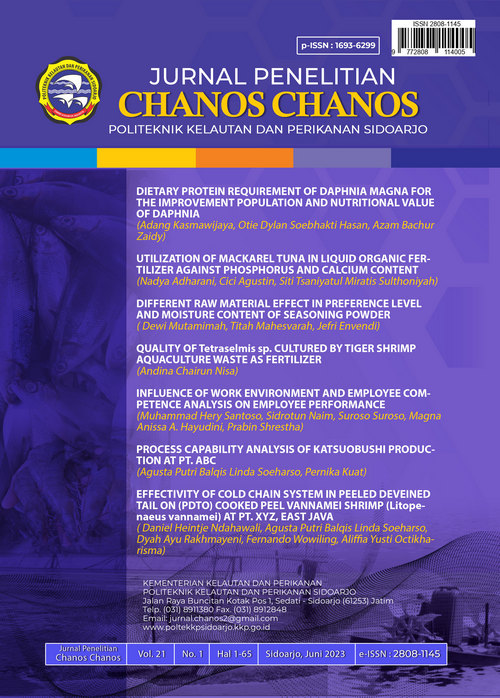
QUALITY OF Tetraselmis sp. CULTURED BY TIGER SHRIMP AQUACULTURE WASTE AS FERTILIZER
DOI:
https://doi.org/10.15578/chanos.v21i1.12747Keywords:
Fluorescence Microscope, Image J, Tiger Shrimp Wastewater, Tetraselmis sp. CellsAbstract
Tiger shrimp aquaculture waste still contained amount of nutrients needed by phytoplankton for its growth. Among nutrients was resulted from intensive aquaculture still can be used by phytoplankton. Phytoplankton used nitrates and phosphates for its growth and development. Phytoplankton requires nitrate concentration in 0,9-3,5 mg/ and phosphate in 0,27-5,51 mg/l. Utilization of tiger shrimp aquaculture waste for Tetraselmis sp. quality can be seen using fluorescence microscope with the cell of Tetraselmis sp. had to stained by acridine orange before observed using fluorescence microscope. The concept of this staining when cells of Tetraselmis sp. radiated green colour showed that cells was alive whereas cells radiated orange colour showed that cells was dead or damaged. This matter caused living cells could reducted acridine orange pigment enzymatically until become green radiated cells, instead damaged cells showed orange colour. Research procedures included cultivating Tetraselmis sp. in various dosages waste of tiger shrimp aquaculture as fertilizer. This various dosages are 2 g/l, 4 g/l, 6 g/l and 8 g/l. Culture media for Tetraselmis sp. was saltwater. Sterile saltwater was put into jars about 1 L and later added wastewater to jars. Reading of protein expression helped using imageJ software that showed histogram graphics accompanied by mean. Mean resulted by graphics indicated protein could be expressed. Based on expression of fluorescence protein with 2 g/l wastewater dosage showed that amount of protein could be ecpressed was higher than other wastewater dosage by mean value from ImageJ.
References
Amalia, R., S. Rejeki, L.L. Widowati & R.W. Ariyati. 2022. The Growth of Tiger Shrimp (Penaeus monodon) and Its Dynamics of Water Quality in Integrated Culture. Biodiversitas, 23(1): 593-600.
Evania, C., S. Rejeki, R.W. Ariyati. 2018. Performa pertumbuhan udang windu (Penaeus monodon) yang dibudidayakan bersama kerang hijau (Perna viridis) dengan sistem IMTA. Jurnal Sains Akuakultur Tropis, 2(2): 44-52.
Fannessia, L, D., N.W.K. Karja, I.K.M. Adnyane, & M.A. Setiadi. 2015. Pelacakan kerusakan akrosom spermatozoa domba selama proses pembekuan dengan teknik histokimia lektin. Jurnal Veteriner 16(4): 560-568
Hadioetomo, R.S. 1993. Mikrobiologi Dasar dalam Praktek. Jakarta: PT Gramedia.
Khemtongcharoen, N., A. Ruangpracha, P. Sarapukdee, P. Wongsawatsuriyha, F. Beadyananda, & W. Piyawattanametha. 2011. Acridine orange staining for cell analysis. Conference Paper. October 2011.
Marsela, K., H. Hamdani, Z. Anna & H. Herawati. 2021. The Relation of Nitrate and Phosphate to Phytoplankton Abundance in the Upstream Citarum River, West Java, Indonesia. Asian Journal of Fisheries and Aquatic Research, 11(5): 21-31.
Meritasari, D., Mubarok, A.S., Sulmartiwi, L., & Masithah, E.D. 2012. Pengaruh pemberian pupuk cair limbah ikan lemuru (Sardinella sp.) dengan dosis yang berbeda terhadap pertumbuhan Chlorella sp. Jurnal Ilmiah Perikanan dan Kelautan. 4 (1): 27−32.
Mtaki, K., M.S. Kyewalyanga & M.S.P. Mtolera. 2021. Supplementing wastewater with NPK fertilizer as a cheap source of nutrients in cultivating live food (Chlorella vulgaris). Annals of Microbiology,71(7). https://doi.org/10.1186/s13213-020-01618-0
Rumanti, M., S. Rudiyanti, & Suparjo, M.N. 2014. Hubungan antara kandungan nitrat dan fosfat dengan kelimpahan fitoplankton di Sungai Bremi Kabupaten Lamongan. Diponegoro Journal of Maquares, 3(1): 168-176.
Shan, Lv, Y. Zhang, P. Steinmann, G.J. Yang, K. Yang, X.N. Zhou, J. Utzinger, 2011. The Emergence of Angiostrongyliasis in the People’s Republic of China: the Interplay Between Invasive Snails, Climate Change and Transmission Dynamics. Freshwater Biol, 56 (4): 717-734
Schäferling, M. 2012. The Art of Fluorescence imaging with chemical sensors. Angew. Chem. Int. Ed. Engl. 51: 3532-54
Suwoyo, H.S., A. Tuwo, Haryati, H. Anshary & R. Syah. 2020. The utilization of solid waste originating from super intensive shrimp farm as organic fertilizers for natural feed productions. IOP Conf. Series: Earth and Enviromental Science 473 (2020) 012110. doi: 10.1088/1755-1315/473/1/012110
Wang, X., & D. Xu. 2013. Studies on the binding of DNA with the inclusion of brilliant green inside the cavity of ï§-cyclodextrin. 2013. Iran. J. Chem. Chem. Eng., 32(2): 41-47.
Zhu, J., J. Du, X. Pei, X. Qin, & B. Liu. 2016. Cultivation of microalgae: a review. Advances in Engineering Research, 112.
Downloads
Published
Issue
Section
License
Authors who publish articles in Jurnal Penelitian Chanos Chanos agree to the following terms:
- Authors retain copyright of the article and grant the journal right of first publication with the work simultaneously licensed under a CC-BY-SA or The Creative Commons Attribution–ShareAlike License.
- Authors are able to enter into separate, additional contractual arrangements for the non-exclusive distribution of the journal's published version of the work (e.g., post it to an institutional repository or publish it in a book), with an acknowledgment of its initial publication in this journal.
- Authors are permitted and encouraged to post their work online (e.g., in institutional repositories or on their website) prior to and during the submission process, as it can lead to productive exchanges, as well as earlier and greater citation of published work (See The Effect of Open Access).