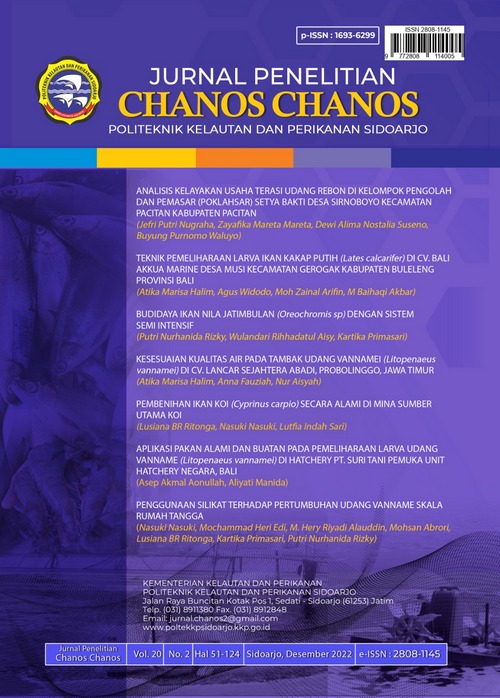
ANALISIS KELAYAKAN USAHA TERASI UDANG REBON DI KELOMPOK PENGOLAH DAN PEMASAR (POKLAHSAR) SETYA BAKTI DESA SIRNOBOYO KECAMATAN PACITAN KABUPATEN PACITAN
DOI:
https://doi.org/10.15578/chanos.v20i2.11747Kata Kunci:
business analysis, shrimp paste, shrimp rebon, PacitanAbstrak
The processing of rebon shrimp paste has been widely carried out by people in the coastal area of Pacitan as a side activity in increasing family economic income and also participating in national development efforts in the fisheries sector. This study aims to measure the feasibility of rebon shrimp paste processing business based on financial (financial) aspects. This research was conducted during September 2022, in Sirnoboyo Village, Pacitan District, Pacitan Regency, East Java. This study uses a quantitative descriptive research method. Descriptive quantitative research method is a method that aims to make pictures or descriptive of a situation objectively using numbers, starting from data collection, interpretation of the data and appearance and results. Sampling of the research was carried out on rebon shrimp shrimp paste entrepreneurs, members of Poklahsar Setya Bakti in Sirnoboyo Village. The feasibility of a business from the financial aspect is measured using the analysis of discounted investment criteria, namely the net present value, the rate of return on investment capital (internal rate of return), the ratio of net benefits to costs (net benefit cost ratio), investment return period (payback period). The shrimp paste processing business carried out by members of Poklahsar Setya Bakti in Sirnoboyo Village has good prospects for development in the future. This business is financially feasible with NPV = Rp. 32,667,112,-. IRR = 21%, Net B/C = 2.1 and a payback period of 3.3 years.ÂReferensi
Arikunto, S. (2012). Prosedur Penelitian Suatu Pendekatan Praktik. Rineka.
Dharma, S., Safrida, E., & Sebayang, R. (2020). Rancang Bangun Mesin Giling dan Cetak Terasi, Pendampingan Manajemen dan Pemasaran. Jurnal Penelitian dan Pengabdian Kepada Masyarakat UNSIQ, 7(1), 11-15
Dinas Kelautan dan Perikanan Kabupaten Pacitan. (2020). Profil Kelautan dan Perikanan Kabupaten Pacitan Tahun 2020. Pacitan: DKP Kabupaten Pacitan.
Djamin, Z. (1992). Perencanaan dan analisis proyek. Fakultas Ekonomi Universitas Indonesia. Jakarta.
Gaffar, A., Umami, S. S., & Supardan, D. (2020). Bacterial pollution of a traditional terasi, shrimp paste rebon (Mysis relicta). In 2nd International Conference on Islam, Science and Technology (ICONIST 2019) (pp. 142-146). Atlantis Press.
Nugraha, J.P., Waluyo, B.P., Rahardjo, R.S., (2021). Analisis Pemasaran Komoditas Perikanan Tangkap dan Strategi Pengembangannya di Kabupaten Pacitan Provinsi Jawa Timur (Studi Kasus di Tempat Pelelangan Ikan Teleng) Jurnal Technofish, Volume V, No 2, Desember 2021
Nursalam. (2008). Aplikasi Statistika Dan Metode Penelitian Untuk Admistrasi & Manajemen. Bandung: Dewi Runchi.
Maulana, I., Yulinda, E., & Hendri, R. (2020). Analisis Usaha Penangkapan Ikan Laut dengan Alat Tangkap Jaring Insang (Gillnet) di Panipahan Kecamatan Pasir Limau Kapas Kabupaten Rokan Hilir Provinsi Riau. Jurnal Sosial Ekonomi Pesisir, 1, 30–38.
Rahmayati, Riyadi, P. H., & Rianingsih, L. (2014). Perbedaan konsentrasi garam terhadap pembentukan warna terasi udang rebon (Acetes SP.) basah, Jurnal Pengolahan dan Bioteknologi Hasil Perikanan, 3, 108- 117.
Unduhan
Diterbitkan
Terbitan
Bagian
Lisensi
Authors who publish articles in Jurnal Penelitian Chanos Chanos agree to the following terms:
- Authors retain copyright of the article and grant the journal right of first publication with the work simultaneously licensed under a CC-BY-SA or The Creative Commons Attribution–ShareAlike License.
- Authors are able to enter into separate, additional contractual arrangements for the non-exclusive distribution of the journal's published version of the work (e.g., post it to an institutional repository or publish it in a book), with an acknowledgment of its initial publication in this journal.
- Authors are permitted and encouraged to post their work online (e.g., in institutional repositories or on their website) prior to and during the submission process, as it can lead to productive exchanges, as well as earlier and greater citation of published work (See The Effect of Open Access).