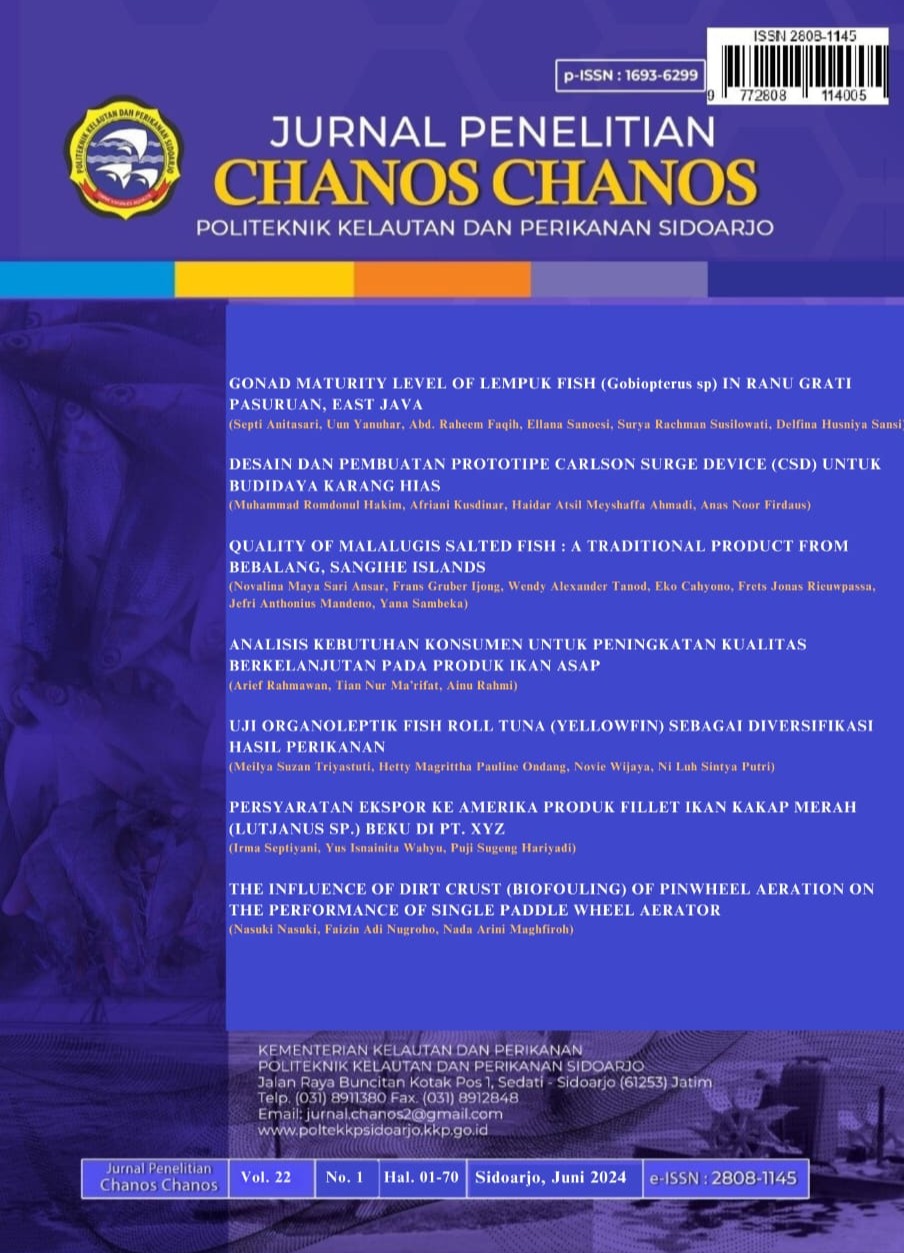
Analisis Kebutuhan Konsumen untuk Peningkatan Kualitas Berkelanjutan pada Produk Ikan Asap
DOI:
https://doi.org/10.15578/chanos.v22i1.14339Keywords:
agroindustri, house of quality, pengembangan produk, UMKMAbstract
Kegiatan pengasapan ikan merupakan usaha pengolahan ikan secara tradisional yang prospek pengembangannya cukup baik. Produk ikan asap merupakan makanan yang siap dikonsumsi karena selama proses pengasapan ikan telah mendapat perlakuan panas yang cukup untuk mematangkan daging ikan dan membunuh bakteri patogen. Penelitian ini bertujuan untuk menganalisis kebutuhan konsumen produk ikan dengan mengimplementasikan metode house of quality. Teknik pengambilan data berupa penyebaran kuesioner skala Likert untuk mengidentifikasi kebuthan konsumen terhadap produk ikan asap serta focus group discussion dengan pemilik usaha untuk mendapatkan data mengenai respon teknis. Hasil penelitian menunjukkan bahwa terdapat dua voice of customer yang menjadi prioritas untuk ditingkatan, yaitu (1) aspek ketersediaan produk yang dapat dibeli di banyak tempat serta (2) peningkatan kualitas tekstur daging ikan asap. Kedua varibel memiliki nilai satisfaction performance 3,512 dan 3,616. Dari sisi respon teknis, standar pengasapan berkontribusi sebesar 4,362 dan standar pengemasan berkontribusi sebesar 2,988 terhadap voice of customer. Hal tersebut menunjukkan bahwa kedua standar perlu untuk dirancang agar produk ikan asap memenuhi kebutuhan konsumen.References
Abdullah, C., & Suliyanthini, D. (2021). Perubahan Perilaku Konsumen di Masa Pandemi Covid-19. Equilibrium: Jurnal Pendidikan, 9(1), 18–24. https://doi.org/10.26618/equilibrium.v9i1.4316
Akao, Y., & Mazur, G. (2003). The leading edge in QFD: past, present and future. International Journal of Quality Reliability Management, 20(1), 20–35.
Aprilia, E. D., Nurfitriana, N., & Yuniarti, T. (2021). Analisis Permasalahan Usaha Perikanan di Kecamatan Cibinong, Kabupaten Bogor, Provinsi Jawa Barat. Jurnal Penyuluhan Perikanan Dan Kelautan, 15(2), 207–226.
Boziaris, I. S. (2014). Seafood processing: Technology, quality and safety. John Wiley & Sons.
Campbell, S., Greenwood, M., Prior, S., Shearer, T., Walkem, K., Young, S., Bywaters, D., & Walker, K. (2020). Purposive sampling: complex or simple? Research case examples. Journal of Research in Nursing, 25(8), 652–661. https://doi.org/10.1177/1744987120927206
Direktorat Jenderal Penguatan Daya Saing Produk Kelautan dan Perikanan. (2020). Sebaran UPI Skala Mikro Kecil Tahun 2019. UMKM Pengolahan Ikan. https://kkp.go.id/djpdspkp/artikel/26307-sebaran-upi-skala-mikro-kecil-tahun-2019
Erdil, N. O., & Arani, O. M. (2019). Quality Function Deployment: More Than A Design Tool. International Journal of Quality and Service Sciences, 11(2), 142–166. https://doi.org/10.1108/IJQSS-02-2018-0008
FAO. (2016). The State of World Fisheries and Aquaculture.
Harpe, S. E. (2015). How to analyze Likert and other rating scale data. Currents in Pharmacy Teaching and Learning, 7(6), 836–850. https://doi.org/10.1016/j.cptl.2015.08.001
Karageorgou, D., Rova, U., Christakopoulos, P., Katapodis, P., Matsakas, L., & Patel, A. (2023). Benefits of supplementation with microbial omega-3 fatty acids on human health and the current market scenario for fish-free omega-3 fatty acid. Trends in Food Science & Technology, 136, 169–180. https://doi.org/10.1016/j.tifs.2023.04.018
Limanseto, H. (2022). Perkembangan UMKM sebagai Critical Engine Perekonomian Nasional Terus Mendapatkan Dukungan Pemerintah. Siaran Pers Kementerian Koordinator Bidang Perekonomian. https://www.ekon.go.id/publikasi/detail/4593/perkembangan-umkm-sebagai-critical-engine-perekonomian-nasional-terus-mendapatkan-dukungan-pemerintah
Mangera, Y., Widanarti, I., & Br Karo, E. R. (2021). Rancang Bangun Alat Pengasapan Ikan dengan Metode Pengasapan Panas (Hot Smoking) dan Pengasapan Dingin (Cold Smoking). Jurnal Teknik Pertanian Lampung (Journal of Agricultural Engineering), 10(4), 504. https://doi.org/10.23960/jtep-l.v10i4.504-514
Maritan, D. (2015). Quality Function Deployment (QFD): Definitions, History and Models. In Practical Manual of Quality Function Deployment. Springer. https://doi.org/10.1007/978-3-319-08521-0_1
Rahmawan, A., & Kholis, M. N. (2017). Implementation of Quality Function Deployment ( QFD ) in Agro-industrial Technology curriculum. Agroindustrial Technology Journal, 01(01), 10–21. https://doi.org/http://dx.doi.org/10.21111/atj.v1i1.1836
Rahmawan, A., & Rosyida, N. N. (2018). Kerangka Konseptual Rancang Desain Produk Yogurt dengan Metode Quality Function Deployment. Jurnal Agroindustri, 8(2), 123–128. https://doi.org/10.31186/jagroindustri.8.2.123-128
Rauniar, R., Rawski, G., Morgan, S., & Mishra, S. (2019). Knowledge integration in IPPD project: role of shared project mission, mutual trust, and mutual influence. International Journal of Project Management, 37(2), 239–258.
Setyoko, A. T., & Kristiningrum, E. (2019). Pengembangan desain sistem keamanan pangan menggunakan Hazard Analysis Critical Control Point (Haccp) pada ukm produsen nugget ikan. Jurnal Standardisasi, 21(1), 1–8.
Sugiyono. (2013). Metode penelitian kuantitatif, kualitatif, dan R&D (1st ed.). Alfabeta.
Taherdoost, H. (2019). What Is the Best Response Scale for Survey and Questionnaire Design; Review of Different Lengths of Rating Scale / Attitude Scale / Likert Scale. International Journal of Academic Research in Management, 8(1), 1–10.
Voldnes, G., Pleym, I. E., Ageeva, T., Alm, S., Nyrud, T., & Rosnes, J. T. (2021). E-commerce of Seafood – A Review of Existing Research. Journal of International Food & Agribusiness Marketing, 33(1), 3–35. https://doi.org/10.1080/08974438.2020.1835779
Wulandjani, H., & Hatta, I. H. (2019). The Analysis of SMEs Business Development Strategy Design in Indonesia. South East Asia Journal of Contemporary Business, Economics and Law, 19(5), 27–30.
Downloads
Additional Files
Published
Issue
Section
License
Authors who publish articles in Jurnal Penelitian Chanos Chanos agree to the following terms:
- Authors retain copyright of the article and grant the journal right of first publication with the work simultaneously licensed under a CC-BY-SA or The Creative Commons Attribution–ShareAlike License.
- Authors are able to enter into separate, additional contractual arrangements for the non-exclusive distribution of the journal's published version of the work (e.g., post it to an institutional repository or publish it in a book), with an acknowledgment of its initial publication in this journal.
- Authors are permitted and encouraged to post their work online (e.g., in institutional repositories or on their website) prior to and during the submission process, as it can lead to productive exchanges, as well as earlier and greater citation of published work (See The Effect of Open Access).