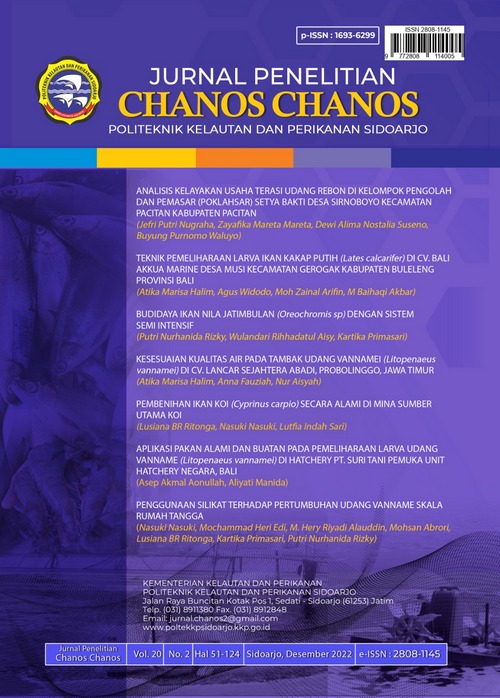
BUDIDAYA IKAN NILA JATIMBULAN (Oreochromis sp) DENGAN SISTEM SEMI INTENSIF
DOI :
https://doi.org/10.15578/chanos.v20i2.11846Mots-clés :
Jatimbulan nile, earth pond, semi-intensive systemRésumé
Low growth performance and survival rate of tilapia is the main problem in tilapia culture especially Nile Jatimbulan. Growth performance of Nile tilapia is highly affected by genetic materials, food quality, stocking density, feeding rate and frequency and environmental factors such as water quality. Semi intensive system in earthen pond were used in this study. Earth pond contain various of organisms which support the growth performance of fish and phytoplankton. In addition, waterwheel with a power of 0.5 HP were added to increase the amount of dissolved oxygen in the pond. To improve water quality and performance of tilapia, EM4 probiotic were applied. This study showed the growth rate of jatimbulan is 2.94 grams, SR 80% and FCR value of 0,6. Jatimbulan tilapia were obtained after 90 days of culture is 6 tons with an average of body weight 250-300 grams.Références
Abdel-Tawwab M, Hagras A.E, Elbaghdady H.A.M, Monier M.N. (2014). Dissolved oxygen level and stocking density effects on growth, feed utilization, physiology, and innate immunity of Nile tilapia, Oreochromis niloticus. J Appl Aquacul 26:340–355.
Aliyas., Samliok N., dan Zakirah R., (2016). Pengembangan dan Kelangsungan Hidup Ikan Nila Yang Dipelihara Pada Media Bersalinitas. Jurnal Sains 5 (1), 19-27.
Akbar, F., Mansur.M., Dewi, N., and Ketut, M. Pengaruh Pemberian probiotik EM4 dengan Dosis Berbeda Terhadap Kelangsungan Hidup Larva Ikan Badut. Jurnal Perikanan Unram, Vol 1(2).
Christin, Y., I.Wayan, R., and Gde, R.A.K. (2021). Laju Pertumbuhan Ikan Nila (Oreochromis niloticus) pada Tiga Sistem Resirkulasi Yang Berbeda. Current Trends in Aquatic Science IV(2); 122 – 127.
Dahril. I., Tang.U.M., Putra.I, (2017). Pengaruh Salinitas Berbeda Terhadap Pertumbuhan dan Kelulusanhidupan Benih Ikan Nila Merah (Oreochromis sp.). Jurnal Berkala Perikanan Terubuk, Volume 45, No.3, November 2017. ISSN.0126-4265
Dardiani. (2009). Pengaruh Aplikasi Probiotik EM4 (Effective Mikroorganisme-4) Terhadap Kelangsungan Hidup Benih Lele Dumbo (Clarias gariepinus). Tesis. Universitas Sebelas Maret Surakarta. (Unpublished).
FAO. (2020). The State of World Fisheries and Aquaculture. Rome.
Gómez G, Roque A, Velasco B. 2002. Culture of Vibrio alginolyticus C7b, a potential probiotic bacterium, with the microalga Chaetoceros muelleri . Aquaculture. 211(1–4):43–48.
Gultom, H dan Mardaleni. 2014. Uji Adaptasi Beberapa Varietas Padi Sawah (Oryza sativa L) dan Kapur Dolomit pada Tanah Gambut, Dinamika Pertanian, 29 (2) : 145-152
Haraz,Y.G., Waleed,N.E., and Ramy, M.S. 2018. Culture Performance of Nile Tilapia (Oreochromis niloticus) Raised In A Biofloc-based Intensive System. AJVS. Vol.58 (1): 166 – 172.
Haroun E, Goda A, and Kabir M. 2006. Effect of dietary probiotic Biogen supplementation as a growth promoter on growth performance and feed utilization of Nile tilapia Oreochromis niloticus (L.) Aquaculture Research. 37(14):1473–1480.
Irianto A and Austin B. 2002. Probiotics in aquaculture. Journal of Fish Diseases.25(11):633–642.
Kumar, G. & Engle, C.R. (2016). Technological advances that led to growth of shrimp, salmon, and tilapia farming. Reviews in Fisheries Science & Aquaculture, 24(2), 136–152. https://doi.org/10.1080/23308249.2015. 1112357 KKP. 2020.
Maimunah, Y dan Yuni,K. 2020. Performance of Growth in Tilapia Fish in Policulture System. J Food Life Sci. Vol. 4(1) : 42 – 49.
Nazir, M.,Syakur dan Muyassir. 2017. Pemetaan Kemasaman Tanah dan Analisis Kebutuhan Kapur di Kecamatan Keumala Kabupaten Pidie. Ilmiah Mahasiswa Pertanian Unsyiah, 2 (1) : 21 – 30.
Patricia,M.C., Ana,L.I., Oscar,A.M.H., and Hugo, C.R.S. 2012. Use of Probiotics in Aquaculture. PMC. doi: 10.5402/2012/916845
Purnama,S., Petrus, H.T.S., dan Taufik,B.P. (2018). Produksi Budidaya Ikan Nila (Oreochromis niloticus) Sistem Bioflok Dengan Sumber Karbohidrat Berbeda. Asian Journal of Innovation and Entrepreneurship 03(2).
Rahman, M.D., Haque., Mohammad and Arifuzzaman. 2021. Growth and Production Performance of Tilapia (Oreochromis niloticus) in Intensive and Semi-intensive Tank Based Aquaculture System Using Floating Feed. 10.22271/fish.2021.v9.i4d.2546.
Ramlah., Eddy, S., Zohrah, H., dan Munid S. 2016. Perbandingan Kandungan Gizi Ikan Nila Oreochromis niloticus Asal Danau Mawang Kabupaten Gowa dan Danau Universitas Hasanuddin Kota Makassar. Jurnal Biologi Makassar (BIOMA). Vol.1 (1).
Sayed, A.F. 2008. Tilapia Feed and Feeding in Semi Intensive Culture Systems. 8th International Symposium on Tilapia in Aquaculture.
Sickney, R.R. 2000. Principle of Warm Water Aquaculture. Jhon Wiley and Sons. Inc: New York. 375 p.
Téléchargements
Publiée
Numéro
Rubrique
Licence
Authors who publish articles in Jurnal Penelitian Chanos Chanos agree to the following terms:
- Authors retain copyright of the article and grant the journal right of first publication with the work simultaneously licensed under a CC-BY-SA or The Creative Commons Attribution–ShareAlike License.
- Authors are able to enter into separate, additional contractual arrangements for the non-exclusive distribution of the journal's published version of the work (e.g., post it to an institutional repository or publish it in a book), with an acknowledgment of its initial publication in this journal.
- Authors are permitted and encouraged to post their work online (e.g., in institutional repositories or on their website) prior to and during the submission process, as it can lead to productive exchanges, as well as earlier and greater citation of published work (See The Effect of Open Access).