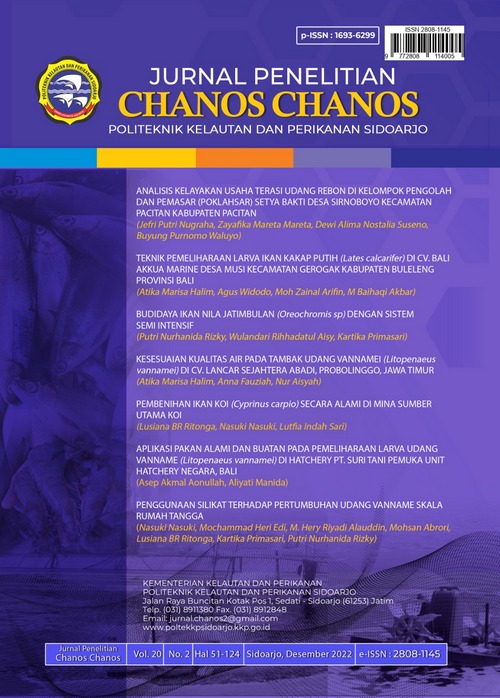
PENGGUNAAN SILIKAT TERHADAP PERTUMBUHAN UDANG VANNAME SKALA RUMAH TANGGA
DOI:
https://doi.org/10.15578/chanos.v20i2.11222Keywords:
phytoplankton, ceraclean, silica, vanname shrimpAbstract
Natural feed such as phytoplankton, contains high levels of protein, fat, and carbohydrates to enhance the growth performance and immunity in shrimp. Moreover, the presence of phytoplankton in the water column can make the waters shady so that it stimulates the shrimp to actively look for food during the day. Silicate is a macro element that used to promote the cell growth and cell wall formation of plankton. Ceraclean fertilizer product is an artificial hydrated calcium silicate with many small pores so that it is easily soluble in water to facilitate nutrient absorption by plankton cells. This study aims to determine the abundance of plankton in vaname shrimp culture ponds with the addition of ceraclean fertilizer and its correlation to the growth of vaname shrimp. This study uses a household-scale circular pond equipped with microbubble aerator technology with a power of 0.5 HP. The stocking density used was 700 fish/m3 and the maintenance period at DOC was 75. The average weight of shrimp growth at harvest was 9.8 grams with a total biomass of 273 Kg with an FCR of 1.1. A total of 262 ind/ml plankton were identified in household-scale aquaculture ponds with a percentage of Chlorophyta 57.20%, Cyanophyta 37%, Crysophyta 5%, Dinoflagellates 0.8% and Protozoa 0%. This study explains the low intake of feed used during the rearing period and the low FCR value because the shrimp utilizes natural feed. This also causes the growth of vaname shrimp in this study to continue to increase every week with an SR value of 90.1%.
References
Carey, J.C., Kathijo. J., Pail. J.I., Lienne. R.S., Patrick. K.T., and Jason. R. 2019. Exploring Silica Stoichiometry on a Large Floodplain Riverscape. Frontiers in Ecology and Evolution. Vol.7.
Christiani, C. 2012. Pemberian Pupuk Urea dan TSP dapat Berpengaruh Terhadap Peningkatan Kesuburan Plankton Kolam. Pp. 1 – 4.
DJPB (Direktorat Jenderal Perikanan Budidaya). 2020. Dukung Target Ekspor Udang 250%, KKP Siap Dorong Produksi Induk Udang Unggul. https://kkp.go.id/djpb/artikel/22598.
KKP. 2018. Budidaya Udang Skala Rumah Tangga. Diakses tanggal 20 Oktober 2020. http://www.djpb.kkp.go.id/arsip/c/446/BUDIDAYA-UDANG-SKALA-RUMAH-TANGGA/?category_id=14
Irsyam, M., Ismin, N., Denny, S.R., Siti. R.D., dan Sahabuddin. 2019. Analisa Usaha Budidaya Udang Vaname (Litopenaeus vannamei) pada Kolam Terpal Bundar dengan Sistem Microbubble. Prosiding Simposium Nasional Kelautan dan Perikanan VI. Universitas Hasanuddin, Makassar 21 Juni 2019.
Junda, M., Kurnia, N.,dan Mis;am Y. 2015. Pengaruh Pemberian Skeletonema costatum dengan Kepadatan Berbeda Terhadap Sintasan Artemia Salina. Jurnal Bionature, 16 (1) : 21 – 27.
Nababan, E., Putra, I., dan Rusliadi. 2001. Pemeliharaan Udang Vaname (Litopenaeus vannamei) dengan Presentasei Pemberian Pakan yang Berbeda. XXXIV: 22 – 24.
Nazmul, A.S.M. 2007. Biological and Chemical Products Use in Extensive Shrimp Farming in Southwest Bangladesh. Journal of Fisheries and Aquatic Science, 2: 56-62
Risamasu, F.J.L., dan Hanif, B.P. 2011. Kajian Zat Hara Fosfat, Nitrit, Nitrat dan Silikat di Perairan Kepulauan Matasiri, Kalimantan Selatan. Ilmu Kelautan, Vol.16 (3). 135 – 142.
Shalindry,R. O., Rochmadi dan Budhijanto. W. 2015. Penguraian Limbah Organik Secara Aerobik dengan Aerasi Menggunakan Microbubble Generator dalam Kolam dengan Imobilisasi Bakteri. Jurnal Rekayasa Proses. 9(2): 58 – 64.
Supito. 2018. Manajemen Teknologi Budidaya Udang Vaname Skala Rumah Tangga. Balai Besar Perikanan Budidaya Air Payau Jepara. Direktorat Jenderal Perikanan Budidaya, Kementerian Kelautan dan Perikanan.
Supono. 2017. Teknologi Produksi Udang. Plantaxia
Supono. 2018. Manajemen Kualitas Air Untuk Budidaya Udang. Aura.
ISBN : 978-602-5940-85-9.
Tangguda, S. 2015. Pemanfaatan Limbah Padat Tambak Udang Vaname (Litopenaeus Vannamei) Dalam Kultur Murni Chlorella sp. Tesis. Universitas Brawijaya Malang. 128 hml.
Umiatun, S., Carmudi., dan Christiani. 2017. Hubungan Antara Kandungan Silika Dengan Kelimpahan Diatom Benthik di Sepanjang Sungai Pelus Kabupaten Banyumas. Scripta Biologicia. Vol. 4. No; 1
WWF. 2014. Budidaya Udang Vannamei, Tambak Semi Intensif dengan Instalasi Pengolahan Air limbah (IPAL). WWF-Indonesia. Jakarta
Yang, D., Gao. Z., Sun.P., Zhao.S., and Zhang. Y. 2006. Silicon Limitation on Primary Production and Its Destiny in Jiazhou Bay, China. Chinese Journal of Oceanology and Limnology. Vol.24 No.2, P. 186 – 203.
Yazwar, 2008. Keanekaragaman Plankton dan Keterkaitannya dengan Kualitas Air di Parapat Danau Toba. Tesis Pascasarjana Biologi USU.
Yuliana, 2015. Distribusi dan Struktur Komunitas Fitoplankton di Perairan Jailolo, Halmahera Barat. Jurnal Akuatika Vol VI No.1.
Downloads
Published
Issue
Section
License
Authors who publish articles in Jurnal Penelitian Chanos Chanos agree to the following terms:
- Authors retain copyright of the article and grant the journal right of first publication with the work simultaneously licensed under a CC-BY-SA or The Creative Commons Attribution–ShareAlike License.
- Authors are able to enter into separate, additional contractual arrangements for the non-exclusive distribution of the journal's published version of the work (e.g., post it to an institutional repository or publish it in a book), with an acknowledgment of its initial publication in this journal.
- Authors are permitted and encouraged to post their work online (e.g., in institutional repositories or on their website) prior to and during the submission process, as it can lead to productive exchanges, as well as earlier and greater citation of published work (See The Effect of Open Access).