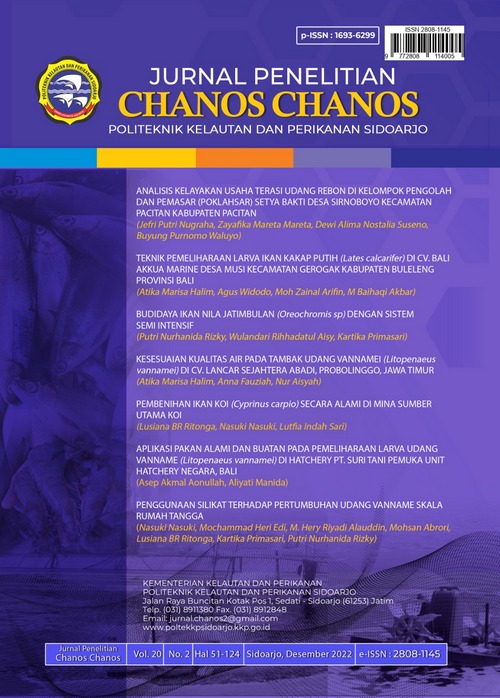
APLIKASI PAKAN ALAMI DAN BUATAN PADA PEMELIHARAAN LARVA UDANG VANNAME (Litopenaeus vannamei) DI HATCHERY PT. SURI TANI PEMUKA UNIT HATCHERY NEGARA, BALI
DOI:
https://doi.org/10.15578/chanos.v20i2.11838Kata Kunci:
Live Feed, Artificial Feed, Larval Rearing, L.vannameiAbstrak
This study aims to determine the application of live and artificial feed in the rearing of vanname shrimp larvae (Litopenaeus vannamei). The work consists of preparation of rearing media, nauplii stocking, feed management and monitoring of larval rearing. A total of 2,000,000 nauplii were used and reared in concrete tanks with a water volume capacity of 14 tons equipped with a filtration system and water changes carried out by flowtrough and circulation. The feed used consisted of livel feed including Chaetoceros muelleri, Thalassiosira sp and Artemia sp. and also artificial feed (commercial feed). The results showed that the application of live and artificial feed during larval rearing was positively correlated with larval stadia development and larval survival rate. Larval development in each stadia, including zoea, mysis and post larvae, showed normal development. The total larval population at each stadia decreased with a final mortality value of 40%. Nevertheless, the survival rate until the end of the PL-10 rearing period was observed to be 60% and this condition was in optimal conditionReferensi
Chanratchakool, P., F. Corsin and M. Briggs. 2005. Better Management Practices (BMP) Manual for Black Tiger Shrimp (Penaues monodon) Hatcheries in Vietnam. NACA, SUMA and THUY SAN. 59 hal.
Elovaara A. K. 2001. Practical technology for intensive commercial shrimp production united states of America. Shrimp Farming Manual. 4(1):100.
Erlina, A., Amini, S., Endrawati, H., dan Zainuri, M. 2004. Kajian Nutritif Phytoplankton Pakan Alami Pada Sistem Kultivasi Massal. Jurnal Ilmu Kelautan, Vol.9 No.4
Gustrifandi, H., 2011. Pengaruh Perbedaan Padat Penampungan dan Dosis Pakan Alami Terhadap Pertumbuhan Larva Udang Windu (Penaeus monodon Fab.). Jurnal Ilmiah Perikanan dan Kelautan. 3(2):241-247. DOI: doi.org/10.20473/jipk.v3i2.11613
Hendrajat, E. M., dan Suryanto, H. 2007. Budidaya Udang Vannamei Pola Tradisional Plus di Kabupaten Maros Sulawesi Selatan. Jurnal Media Akuakultur 2(2) : 67–70
Herawati, V.N., Johanes, H., & Ocky, K.R., 2014. Nutritional Content of Artemia sp. Fed with Chaetoceros calcitrans and Skeletonema costatum. HAYATI Journal of Biosciences. 21(4):166-172. DOI: doi.org/10.4308/hjb.21.4.166
Hidayat. K. W., I. A. Nabilah., S. Nurazizah., dan B. I. Gunawan. 2019. Pembesaran Udang Vaname (Litopenaeus Vannamei) Di PT. Dewi Laut Aquaculture Garut Jawa Barat. Jurnal of Aquaculture And Fish Health. 8(3):123-128
Le, T.H., Hoa, N.V., Sorgeloos, P. & Van Stappen, G., 2018. Artemia feeds: a review of brine shrimp production in the Mekong Delta, Vietnam. Reviews in Aquaculture, 11(4):1–18. DOI: 10.1111/raq.12285Marihati et al., 2013.
Nengsih, E. A., 2015. Pengaruh aplikasi probiotik terhadap kualitas air dan pertumbuhan udang Litopenaeus vannamei. JURNAL BIOSAINS, 1(1): 11–16.
Perdana, P.A., Lumbessy, S.Y., Setyono, B.D.H. 2021. Pengkayaan Pakan Alami Artemia sp. dengan Chaetoceros sp. pada Budidaya Post Larva Udang Vaname (Litopenaeus vannamei). Journal of Marine Research, 1 (2) : 252-258
Pérez-Morales, A., Band-Schmidt, C. J., & MartÃnez-DÃaz, S. F. (2017). Mortality on zoea stage of the pacific white shrimp Litopenaeus vannamei caused by Cochlodinium polykrikoides (Dinophyceae) and Chattonella Spp. (Raphidophyceae). Marine Biology, 164 (3)
Prawira, M. A., Sudaryobo, A., & Rachmawati, D. 2014. Penggantian Tepung Ikan Dengan Tepung Kepala Lele Dalam Pakan Terhadap Efisiensi Pemanfaatan Pakan dan Pertumbuhan Juvenil Udang Vannamei (Litopenaeus vannamei). Journal of Aquaculture Management and Technology Vol. 3 No. 4
Purba, C.Y., 2012. Performa Pertumbuhan, Kelulushidupan, dan Kandungan Nutrisi Larva Udang Vaname (Litopenaeus Vannamei) Melalui Pemberian Pakan Artemia Produk Lokal yang Diperkaya dengan Sel Diatom. Journal of Aquaculture Management and Technology, 1(1):102– 115
Putri, T., Supono, Putri, B. 2020. Pengaruh Jenis Pakan Buatan Dan Alami Terhadap Pertumbuhan dan Kelangsungan Hidup Larva Udang Vaname (Litopenaeus Vannamei). Jurnal Akuakultur Rawa Indonesia, 8 (2) : 176-192
Sektiana, S. P. (2008). Pengembangan Medium Untuk Kultur Semi Massal Diatom Laut Chaetoceros gracilis Schutt. Tesis. Pascasarjana. IPB Bogor
Standar Nasional Indonesia (SNI). 2009. Produksi Benih Udang Vannamei (Litopenaeus vannamei) Kelas Benih Sebar. SNI 7311:2009
Subaidah, S., Susetyo P., Mizab A., Tabah I., Gede S., Detrich N. Dan Cahyaningsih. 2006. Pembenihan Udang Vannamei (Litopenaeus vannamei). Balai Budidaya Air Payau Situbondo. Situbondo
Suriadnyani. N.N., Kadek. M., dan Tati A.N. 2007. Pemeliharaan Larva Udang Vannamei (Litoppenaeus vannamei) dengan Pemberian Fitoplankton yang Berbeda. Jurnal Penelitian dan Rekayasa Perikanan. Balai Besar Riset Perikanan Budidaya Laut Gondol. Bali
Sutomo. 2005. Kultur Tiga Jenis Mikroalga (Tetraselmis sp, Chlorella sp, dan Chaetoceros gracilis) dan Pengaruh Kepadatan Awal Terhadap Pertumbuhan Chaetoceros gracilis di Laboratorium. Jurnal Oseanologi dan Limnologi di Indonesia
Wyban, J. A. dan J.N. Sweeney. 1991. Intensive Shrimp Production Technology. Honolulu, Hawaii, USA
Unduhan
Diterbitkan
Terbitan
Bagian
Lisensi
Authors who publish articles in Jurnal Penelitian Chanos Chanos agree to the following terms:
- Authors retain copyright of the article and grant the journal right of first publication with the work simultaneously licensed under a CC-BY-SA or The Creative Commons Attribution–ShareAlike License.
- Authors are able to enter into separate, additional contractual arrangements for the non-exclusive distribution of the journal's published version of the work (e.g., post it to an institutional repository or publish it in a book), with an acknowledgment of its initial publication in this journal.
- Authors are permitted and encouraged to post their work online (e.g., in institutional repositories or on their website) prior to and during the submission process, as it can lead to productive exchanges, as well as earlier and greater citation of published work (See The Effect of Open Access).